IN THIS ESSAY I’ll provide context on Charli xcx’s sense of her place in the industry, connecting Music, Fashion, Film to something she’s always done! I’ll use a term “ironic sincerity” to illustrate the album’s spiral structure! I’ll provide thoughts per track! Analyze the album’s aesthetic! And close bringing them all together!
~
In a 2022 Zane Lowe interview Charli xcx said “I’ve always been in the throws of, “Am I a pop girl?” Zane chimes in, “…Am I weird? Am I pushing this forward? Or am I trying to find my seat at the table?” She agrees, but elaborates:
I feel like there has been this narrative around me: progressive, future of pop… I also feel like we’re at a time where the music industry is starting to catch up with me, a little bit. We’re at this time now where being an artist like me is actually quite common, and the norm. You know, with things like hyperpop existing, that’s now a tangible genre that not only weird kids who have great taste can understand, but playlisters can understand.
As Charli felt the industry understanding her approach she added, “It’s interesting my reaction isn’t ‘Great!’ it’s ‘Oh, I need to reject all of it.’ Now I need to figure out how to alienate myself again.”
Two years later, Brat received critical acclaim, chart success, and two successful tours (Sweat and the Brat World Tour). Sputnikmusic wrote, “Brat feels like the culmination of a hard-fought career … Charli has somehow squared circle of reconciling universal accessibility with once again upping the ante on her vision of pop’s future.” The Guardian: “Most of her superstar peers are busy making unrelatable music about how hard it is to be famous. Yet Charli has never lost sight of how hard it is to be human.” Exclaim: “A rare and energetic vision of unfiltered creative impulse from a brilliant prophet of pop.” Pitchfork: “The best-sounding version of the Charli XCX promise to make the Apollonian pop landscape Dionysian again.”
Critics may still wonder if Charli is ahead of the curve, if she’s still a “prophet”, if she still has a “promise” to keep. Meanwhile, she’s getting tired of that narrative.
Music, Fashion, Film uses an aesthetic that may alienate listeners through drones, minimalism, underplayed rock instruments, and detached vocal performance underlining intense subject matter. Brat dealt with rivalry, aging, the choice not to have kids, and losing collaborators while Music, Fashion, Film uses those subjects to explore identity. Rather than defining “the future of pop”, Charli is more interested in creative exploration that honours herself and her collaborators.
She creates in a mode I’d call “ironic sincerity”, a specific quality of writing that is at times blunt, funny, deadpan, and vulnerable. The approach that was all over Brat has now become more stark. For Charli, meaning doesn’t come from landing on the right word, it comes from moving back and forth.
~
For this next section I’ll focus on lyrics, and occasionally comment on production. More general thoughts on production follow afterward.
The tracklist resembles an inward spiral as subjects start broad, then increasingly narrow until Charli can face the world, only to be confronted by mortality:
Genre – Rock Music
Industry roles – SS26
Hobbies – Card Declined
Creative diversions – Camera
Over-simplification – 2007
Fear – I’m Afraid
Ambivalence – Yeah
Armour – Wink Wink
Conflict – Persona
Friendship – Magic Metal Montana
Mortality – No One Lasts Forever (feat. David Cronenberg)
Rock Music
This song serves as a “filter” that calls attention to what the album is: it’s not a rock album, it’s a Charli xcx album. Over a four chord loop, the first lyric is self-evident, “Me and my friends, we go out / We take pictures and make stuff together”. Any catharsis from the chorus is undercut by it being nearly unsingable: “R-o-o-o-o-o-o-o-o-ck” relies on a looped, clicking, vowel sound. The open chords last only a few seconds before we return to restrained vocals on Verse 2:
Wow
I’m really banging my head
I’m really hurting my neck
The nervе damage is real
But it’s the only way to feel somеthing
Hurt yourself
Yeah, maybe jump off the stage
I hope they catch you today
But if they don’t, it’s okay
These hint at the darkness the album is about to explore. She literally bangs her head on stage, has suffered nerve damage on tour, and hurt her neck during a crowd-surfing stunt for the “Rock Music” video. Metaphorically, she’s perhaps banging her head against a wall, but it’s the only way she feels good about being creative. If an audience misses the point, she simply says it’s okay.
The filter here is production. The song is called Rock Music, while any rock fan will note the edited, narrow guitar positioning, the minimal drums, the simple chord loop. If this is what the creative team calls “rock”, rock fans might lose interest, while curious listeners might wonder what the hell is going on.
SS26
The first emotional pivot is a smooth move to self-questioning. “Spring Summer ’26” illustrates a particular anxiety about public life (But I didn’t do it, even if I did / Wrote a really good notes app apology). Everything gets filtered through a lens of surface level appeal (Yeah, we’re walkin’ on a runway that goes straight to hell). That anxiety bleeds into worry about whether one has the right politics, the right heritage (Think my politics could work as a press strategy / And my heritage could give me quite thе USP [unique selling point]), and ultimately choosing to focus on surfaces anyway (Can’t hide the fact I’d rather take the easy road / Yeah, I think I’ll be alright if I look good in the clothes).
Charli is unsure how to behave in an industry that relies on image and self-promotion. Sometimes this involves dressing well, while the more difficult part is engaging fans, going to industry events, and striving for authenticity in spaces that reward it in one moment then punish it the next.
Card Decline
This next emotional pivot is sharper, as she goes shopping while depressed. Sure consumerism is hollow, but around 1:40 the song changes modes to something sung in a bittersweet minor key. It reads to me as mania after a fever of depression has broken. This is flipped once more at 2:50 for a b-side called Thinkin’ Bout You, which fully turns the mania toward a crush or romantic interest. A reflexive denial, “I don’t want to think about this right now”, so the narrator tries to disappear into a romance.
To me, beginning in a dark mode, then shifting lighter and lighter almost reflects “resisting the process”. As self-reflection begins… Actually, take a little shopping break! Go on a date! The avoidance feels psychologically believable.
Camera
One of the more accessible verse-chorus-bridge songs of the album. Charli wrestles with her interest in acting (Do I wanna make music? Am I being fuckin’ stupid / If I try to be a girl on the screen when I’m turning thirty-four?). She’s interested in acting because it feels good (‘Cause all I know is how it makes me feel), and it’s a welcome escape from a creative process that involves intense self-questioning (Cause it’s the only way to feel like I’m not actually me).
Seen pessimistically, confessional songwriting and authenticity are self-defeating: it can be draining to inhabit negativity, but even if one creates an honest, cathartic document of an intense feeling, time can create distance from the emotions that inspire initially authentic work, such that returning to it starts to feel like lying. At what point does the performer let go of the work in order to stay true to themselves? Acting has none of this baggage because actors interpret scripts, not present their true self and ideas.
Until this point we’ve inhabited her aesthetic choice, her industry behavior, a perhaps toxic shopping habit, and “Camera” is where Charli’s concerns of perception and performance become most explicit. She starts to see the value in playing characters because they feel like a relief from being “herself” all the time. Unfortunately for her, acting is a job, and she has to live with herself at the end of the day.
2007
The denial of “Card Decline” returns. Charli’s voice is pitched-up sounding like a younger version of herself. The beat is relatively simple and bright. When the song mostly repeats lines (I can take you to heaven like it’s 2007 / P-pop star in my bedroom like it’s 2007), she embodies her inner child, a girl who wants and enjoys attention and has an uncomplicated relationship with that desire. 2007 is the year before she started sharing music, arguably a more innocent time in her life. Later lyrics (Pictures on the sofa become pictures on the screen / All from your apartmеnt, you can shine bright like a star) carry weight, the ego conflates sexual attention and fame as equally gratifying, using the language of performance to flirt. Notably, the language has simplified dramatically – something that happens again in “Yeah” when the journey becomes more abstract. Here, abstraction produces denial, while later abstraction produces catharsis.
I’m Afraid
Here is perhaps the harshest tonal shift of the album. After flirting and thinking about a simpler time in her life, Charli’s anxiety about her marriage result in one of her darkest choruses:
I’m a wife, I’m a kid
I’m destroyed, I’m a bitch
I’m too drunk, I can’t sleep
I can’t feel, I’m afraid
I’m afraid, I’m afraid
I’m nothing without him
What if I ruin it?
Take the ring, take the ring
She questions her role in relationships because that is what singer-songwriters are expected to do (All this pain makes me believe I’m a better artist now / An excuse I tell myself to act selfishly). Having complex feelings can be generative, but becomes debilitating if the artist repeats unhealthy relationships. She knows self-awareness isn’t improving her life, but senses she needs to keep going.
Yeah
As we reach the center of the inward spiral, the tone shifts toward ambivalence. Charli simply repeats “I don’t wanna”, until eventually, “Wait. Now I wanna feel it”. The cathartic chords are immediately followed by guarded delivery to an unnamed adversary: “You don’t wanna”… Until of course, “You’re so predictable / Wait, now you wanna feel it”, and the cathartic guitar returns.
The song can be read as a back and forth she experiences in her creative process and public perception. Sometimes she wants to create and perform, other times she doesn’t, sometimes she has an enthusiastic audience, sometimes she doesn’t. She processes that ambivalence, naturally, with the song’s reserved “yeah”. It’s both exhausted and genuine.
When I mentioned these lyrics are abstract, I mean they seem to operate pre-language. There’s a therapeutic aphorism, “You have to feel it to heal it”, suggesting that language and explanation aren’t the whole process; change comes from accessing feelings.
After this point the spiral turns outward, but the tonal pivots remain consistent.
Wink Wink
This moment strikes me as a defense mechanism solidifying. Charli has finished self-exploration and now protects her ego with the armour of irony. This can be read as a response to conclusions people made about her during the Brat era (Here’s the truth, and I gotta be honest / I’m not a bad girl anymore / Wink, wink, wink, wink). She would rather joke about public perception because it’s easier psychologically, but allows just enough space to change her mind if she wants.
For now, she navigates pressure with a wink and nod. She knows audiences are perceptive, and to protect her sanity she places a boundary between her and the public.
Persona
That doesn’t mean the pivots are over. Charli immediately comments on “Wink Wink” by calling out the defense mechanism. Whether this is a song about her own persona, or someone else is a feature of the writing, not a bug. She famously explored projection and industry rivalry in “Sympathy is a Knife”, and “Girl, So Confusing”, and now continues troubling self-examination while criticizing another persona. She’s aware of persona as a tool to navigate:
The industry…
We’re both under the influence of life imitating art
And we both know it
Interpersonal relationships…
I think I’m so clever, you think I am too
I know you see me when I see you
Marketing…
I see your face in a film. And it makes me wanna cry
I love the stories you tell
But I can tell when you lie
And self-preservation…
I know you’re performing
I know that you’re hurting
So you try to hide it when you see me coming
Don’t wanna confront it, I’m scared I’m annoying
These lyrics work as self-examination and as a conversation with a rival. If Charli xcx is her own worst enemy, it’s perhaps both.
Magic Metal Montana
We next pivot toward complete sincerity in a song about her friendship and collaboration with A.G. Cook. According to Rolling Stone, he thought the song was sweet but an anomaly on Music, Fashion, Film, admitting surprise she kept it.
I see it as a culmination of themes. The drama of self-exploration and creativity isn’t solved by friendship, it’s made easier. Charli loves music, so a friend who helps her create without either explaining every choice (You’re my best friend, but we don’t talk / We make music, we talk that way) means this is one of her most important relationships. She shared that when she played this song for her close friend Aidan Zimiri, he was glad, because she was only able to write a tribute retrospectively for her friend and collaborator Sophie (“So I” and A.G. Cook’s remix).
No One Lasts Forever (feat. David Cronenberg)
Finally, confessing a friend’s importance triggers a reminder that nothing lasts forever. Fame is enjoyable but temporary (I don’t wanna go home / Now I’m more confident than ever / Since everyone knows my name / All the parties got better), then the song widens to ego death and impermanence. Charli ultimately seems to find the entire experience important:
But you need to discover that feeling
Of the crushing highs and lows of ego
Where one minute you know you’re the worst
And the next minute you know you’re better
Than everyone in the room
The process of going from niche to well-known artist resulted in a period of intense questioning for Charli. To grow creatively and personally, she used a period of validation to ask whether she wanted to be known for one thing. Cronenberg’s extended outro describes oblivion as “freedom”. Losing the highs feels like a tragedy, losing the lows may result in peace.
~
Overall, most listeners probably won’t struggle with Charli’s voice or lyricism. The biggest swing is instead the aesthetic of the album: its sound, music videos, and album cover.
Her producers A.G. Cook and Finn Keane have done variations of hyperpop for over ten years, so they’re understandably tired of that aesthetic. Pop music now borrows from the genre in different ways: vocals are pitched, beats are stretched and mixed in surprising ways, confession and humour regularly sit side by side.
In Music, Fashion, Film, Cook and Keane approach drums and guitar with their longstanding sensibilities. “Rock Music” uses a chopping, looped chord as the first thing a listener will hear starting the album. “Card Declined” initially used a faster, conventional rock loop, then slowed it down significantly using a digital process to affect the texture of every instrument, giving the song a dark, shambling quality. “2007” uses a pitched vocal implying mania rather than innocence. On a recent Tape Notes, Charli and Cook specifically talked about not rocking too hard. “What a nightmare,” she says, knowing they’re outsiders of the genre. The goal was not to make a rock album. It was to try something new for them. In the same way they interpreted electronic pop for a decade, they interpreted rock. Funny enough, this might bother hyperpop and rock fans alike, because neither gets the aesthetic they expect.
Simultaneously, the music videos have almost nothing to do with existential inquiry. Three of four were shot and directed by Aidan Zimiri, and all four can be described as breezy, suggestive adventures through fabulous settings. Charli’s still interested in flashy set pieces: the cigarette piles in “Rock Music”, the X-shaped runway in “SS26” where she plays different characters, overt sexuality in public spaces in “Wink Wink”, and a frustrated actor navigating a chaotic film set (shot in one take) in “Camera”. All the videos are interested in visibility and perception, and conveniently fit the album title Music (Rock Music), Fashion (SS26), Film (Camera). “Wink Wink” is the outlier, almost begging the viewer to question where it fits.
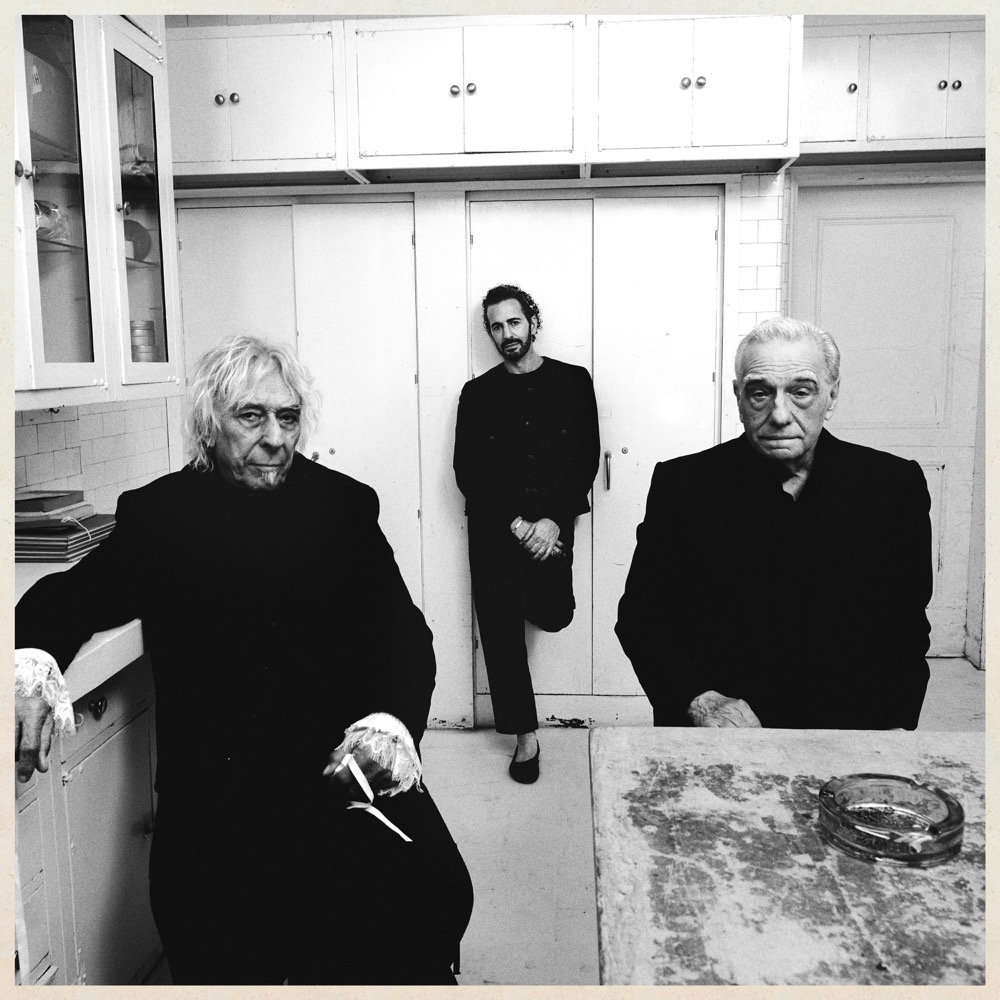
The album cover, also shot by Zimiri, does not feature her or the album title. It instead shows John Cale (musician of the Velvet Underground), Marc Jacobs (fashion designer), and Martin Scorsese (filmmaker).
Despite the album title, Charli resists simple celebrations (In SS26: Nothing’s gonna save us, not music, fashion or film). Even though she expresses herself through music, fashion, and film they are only mediums. No matter how influential or “iconic” someone’s work becomes, the artist can still be reduced to a distant black and white portrait. The album cover manifests her concern that a multifaceted, prolific artist can be reduced to one thing. Becoming an icon can also be limiting.
The visuals almost encourage the viewer to ask “How did they do this?” Quite simply, Charli used the success of Brat to allow herself to explore a different sound, afford technically impressive tongue-in-cheek videos, and book three arguably unbookable men to appear in the same room.
~
On Tape Notes, the host asked “Have you learned something since we last spoke?” Charli replied:
I think honestly the last song on the record summarizes where I’m at.
Sometimes making music can be hard, but for me it’s hard not when I’m in the room doing it. It’s more these other things at play outside of the studio that can make releasing music feel hard. And most of that is in some way related to ego. For the most part when I’m making music, especially with you two (she gestures to A.G. Cook and Finn Keane), I do have so much fun.
It’s kind of my favourite part of the process. I’ve learned that not only from making this album, but making Brat, too. Making the album is the best bit. All the other stuff can be good, but it’s less good than actually making it. Enjoy making the stuff, because that’s the peak. That’s the pinnacle. That’s why you do it.
She’s written about the fantasy of public life, “One of the main realities of being a pop star is that at a certain level, it’s really fucking fun. You get to go to great parties in a black SUV and you can smoke cigarettes in the car and scream out of the sunroof and all that cliche shit.” Then:
You will also end up spending a lot of time inhabiting strange and soulless liminal spaces. Whether its the holding area of the event you’re about to enter, the airport lounge, the visa office, the claustrophobic tour bus, the greenroom with no windows, the underneath of a stage or the set build of a photoshoot or music video you’re on, you are often caught in the in-between.
She concludes:
All my favorite artists are absolutely not role models nor would I want them to be, but maybe that’s just me. I want hedonism, danger and a sense of anti establishment to come along with my artists because when I was younger I wanted to escape through them. I don’t care if they tell the truth or lie or play a character or adopt a persona or fabricate entire scenarios and worlds. To me that’s the point, that’s the drama, that’s the fun, that’s the FANTASY.
Music, Fashion, Film argues that self-exploration and creativity are best done with friends, and even more meaningful because life is short. The spiral of genre commentary, ambivalent acceptance, complicated perseverance and death avoids satisfying summary. For Charli xcx, the most reasonable move is to create deeply considered, personal work, then insist that art is one part of life. It may divide listeners, but those willing to invest in the vision will find something far more cohesive than the parts first appear.
Sources:
- Charli XCX on Zane Lowe (Crash Interview), 2022 https://www.youtube.com/watch?v=61409OxvOEg&t=420s&pp=ygUaemFuZSBsb3dlIGNoYXJsaSB4Y3ggY3Jhc2g%3D
- Tape Notes Ep 185 – Charli xcx, A.G. Cook, Finn Keane, 2026 https://www.patreon.com/tapenotes/posts/tn-185-charli-g-164476023
- Charli xcx by Rolling Stone, 2026 https://www.rollingstone.com/music/music-features/charli-xcx-new-album-music-fashion-film-brat-1235576603/
- The Music Fashion Film Interview – Nicky Reardon, 2026 https://youtu.be/g1pOJhEIrVs?si=8T7Y3cVVgK730A55&t=1193
- The realities of being a pop star. – Charli xcx’s substack, 2026 https://substack.com/home/post/p-179505702
Audio quotes have been edited for clarity.